

2025 building consents boom could trigger another 5,000 residents
 Share
Share
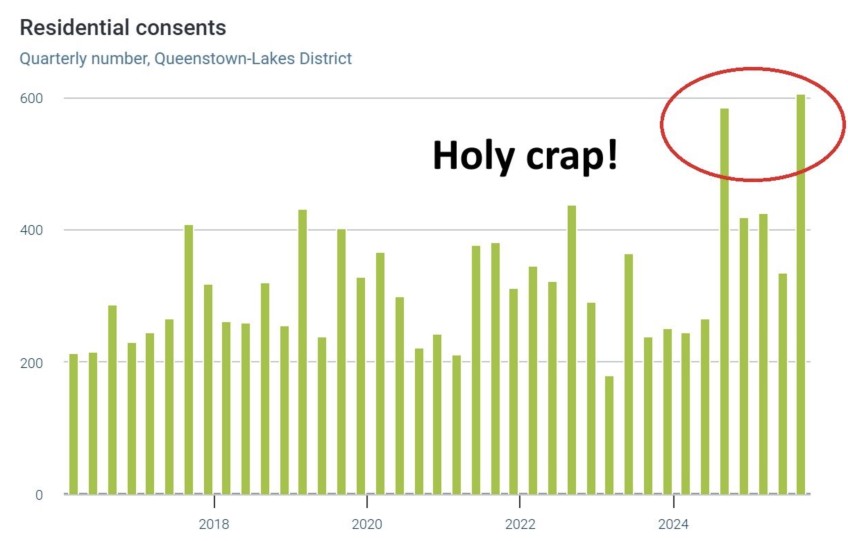
Local economist Benje Patterson has warned that the “kitchen sink” needs to be thrown at the Queenstown Lakes infrastructure deficit after posting the latest building consents data on social media - and adding “Holy Crap!” to the chart. (Above - from LinkedIn.)
Mr Patterson added his own comments to the data:
“Building consents in Queenstown Lakes hit a record 605 in the September quarter - taking consents to almost 1,800 over the past year. The construction sector in the resort is gearing up for a huge 2026, but even more intriguing for me is the potential jump in population we will see over the next 12 to 18 months as these homes are constructed.
”Even factoring in 27% of homes on average in Queenstown that end up not being permanently occupied (i.e. holiday homes and Airbnbs), these new dwellings could welcome 4,000 to 5,000 new residents. That is a pretty crazy potential lift in the population when you consider we only have just over 50,000 permanent residents!
”The kitchen sink needs to be thrown at our transport infrastructure (not to mention water, waste, energy, health, and education infrastructure) - otherwise bottlenecks that we are seeing at certain times will become round-the-clock.
“Just-in-time delivery does not work here like it does in slower growing places. Standard public sector-led infrastructure delivery models don’t work here, there is a role for innovation and private sector partnerships with the community and government agencies to help meet needs now.”
Mr Patterson’s comments come as central Government offloads more costs onto local government and is to introduce a rates cap.
With next year’s general election less than 12 months away, pressure is expected to build on Government Ministers to finally acknowledge that a constant increase in population and visitor numbers in the Southern Lakes will have to be met by some type of taxpayer funded infrastructure investment.
The current Regional Deals strategy sets the scene for increased private sector infrastructure involvement but its hard to see how this strategy alone can take the heat - and potential irreversible damage to our natural environment - out of such a rapid and dramatic growth curve.
Expect it to be a major, national election issue.


TOP STORIES